
Personal Branding With an AI Business Card
A personal brand is what people say about you when the page is silent. How an AI business card changes the three old constraints of personal branding — consistency, availability, and voice — and how to build one that sounds like you rather than like marketing.
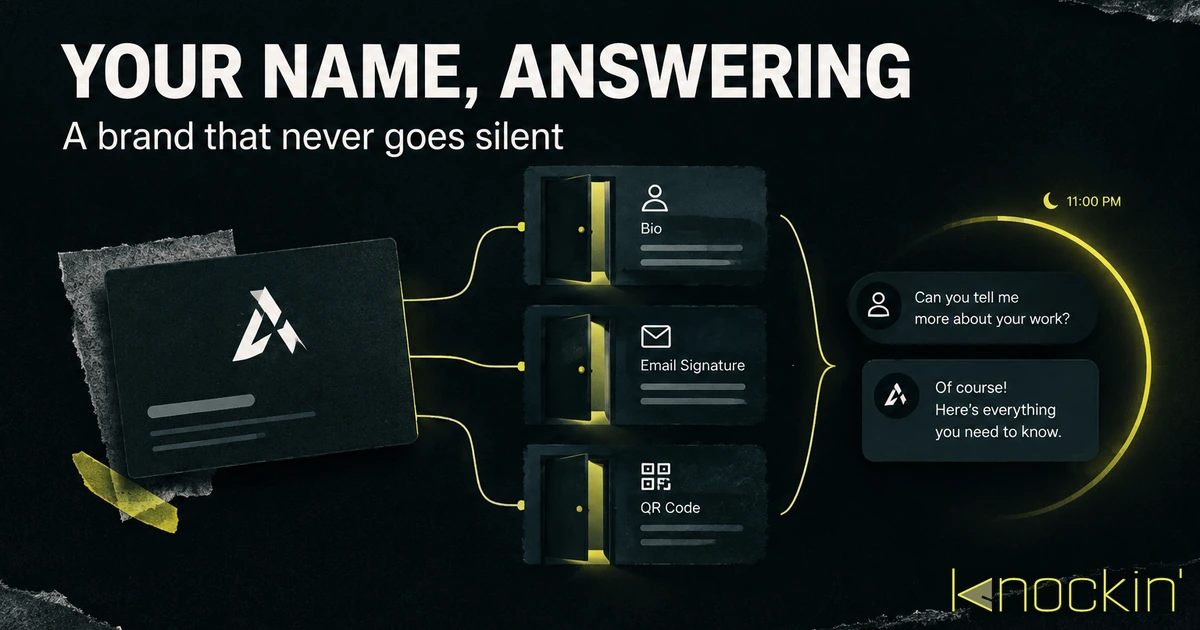
Personal branding advice has always had a strange gap at its center. The books tell you to be consistent, be visible, be memorable — and then hand you tools that go silent the moment you stop feeding them. The carefully written bio ages. The personal site sits there, saying the same six sentences to every visitor, forever. The brand exists, but only in the way a photograph exists: accurate, static, and unable to help anyone who has a question about it. An AI business card closes that gap in a specific, practical way, and this article is about how — not as a hype piece, but as a look at what actually changes when your introduction can answer back.
What a Personal Brand Actually Is, Online
Strip the influencer connotations and a personal brand reduces to something plain: what people can say about you after encountering your work. If they met only your LinkedIn, could they explain what you do and who you do it for? If they saw only your conference talk, would your bio page tell them the same story?
That test exposes the three constraints every online brand has always struggled against:
Consistency. Your story lives in six places — LinkedIn, a portfolio, an X bio, a company team page — and they drift apart the moment your title changes in one of them. Visitors hit whichever version ranks, and no two visits are guaranteed the same you.
Availability. Interest doesn't schedule itself. The person who finds you at 11pm on a Sunday, mid-question, gets a page — not a person — and whatever they couldn't figure out is now your follow-up problem, or a lost opportunity.
Voice. This is the subtle one. A brand isn't just facts; it's how you say them. Most online presences flatten voice into positioning language — the same energetic adjectives everyone uses. What makes you you survives mainly in your actual writing and conversations, and almost nothing else in the online toolkit touches that.
Every tool you know attacks one of these at most. A good bio page helps consistency. Analytics help you notice availability gaps. Voice has no tool at all. The interesting thing about an AI business card is that it works on all three at once — because it isn't a static page, it's one that responds.
Consistency: One Profile, Every Door
The card layer of an AI business card is a live profile — the same single source of truth a good digital business card gives you: update once, and every QR code, link, and signature you've ever shared now carries the new version. The mechanics of that are covered in how digital business cards work, and the field-by-field decisions in what to put on a business card.
For branding specifically, the profile does something a LinkedIn can't: it is the only version. You stop maintaining six halves of one story and start maintaining one whole one. Your bio page, your email signature, the QR on your talk slides, the link in your social profiles — all of them now speak from the same source, which is the most underrated form of brand consistency: not repetition, but the absence of contradiction.
Availability: Your Name Answers at 11pm
Here is the change that matters. With a static presence, the interested stranger does all the work: reads, guesses, clicks through, composes an email, waits. Most don't. With an answering card, the visitor asks — "do you do advisory work," "what's your availability," "is this the right service for a team of three" — and gets an answer from your material, immediately, whether you are asleep, on a flight, or in back-to-back meetings.
The branding consequence is bigger than the convenience one. In the moment a question forms, whoever answers it owns the impression. If the answer is silence, the impression is "move along." If the answer is accurate and in your voice, the impression is you — competent, responsive, worth circling back to. Availability stops being a personality trait ("he replies fast") and becomes a property of your infrastructure. For people whose brand is their responsiveness — consultants, freelancers, anyone whose next client is currently a stranger with a question — this is the entire game.
And because the card can take the next step — pointing to the right link, offering a calendar slot — availability extends past the answer into action. The brand doesn't just respond; it moves the relationship forward.
Voice: The Part That's Actually You
This is where AI business cards get genuinely interesting — and where they can go wrong, so it deserves the most care.
A good answering card is trained on your real material: your about page, your writing, the answers you actually give. Done right, the visitor experiences your cadence, your qualifiers, your sense of humor in the answers — the stuff that makes a brand feel like a person. Done lazily, fed positioning language, it sounds like every chatbot ever demoed, which is worse for a personal brand than silence, because it implies you're a template.
So the discipline is: train on primary sources. Your actual explanation of your work, not the LinkedIn headline. Your real FAQ, including the answers that begin "it depends, but usually..." Those imperfections are the brand. And because the material is yours and editable, the voice stays yours as it changes — retrain it when your positioning shifts, the way you'd update a bio, and the same testing-before-sharing loop from how to create an AI business card applies: interrogate it like a stranger before you let it represent you.
One boundary worth stating plainly: an AI business card is your introduction, not your replacement. It handles first contact and first questions; the relationship that follows is still yours to show up for. The card's job is making sure the relationship gets to start.
Putting It to Work
The practical setup is small. Build the profile with the material that answers "what do you do" (Step one is genuinely the work — gathering what it will speak from). Put the link where first impressions already happen: your social bios, your email signature, your speaker page, the QR on anything you hand out. The full distribution map is in how to share a digital business card, and the case for why this format beats a plain link list for strangers is in AI business card vs link-in-bio.
Then maintain it like what it is: a brand asset. When your offering changes, the source material changes. When you notice the same question arriving week after week, answer it in the material once and let every future visitor benefit. A card that fields a thousand questions builds a running record of what your network actually asks — debrief it occasionally, and your brand gets sharper for free.
Where Knockin Fits
This is what we built Knockin to be: a card you feed your real material, that learns to answer in your voice, greet whoever arrives, share the right context, and turn interest into meeting requests you confirm — one profile behind every door you share, link, QR, or wallet pass. Personal branding finally gets the thing it always needed and never had: an introduction that keeps working when you can't. You can start one free, no credit card required. [Source: https://knockin.info/]
Conclusion
The old tools made personal branding a broadcast: consistent-ish, available-ish, in a voice that mostly wasn't yours. An AI business card turns the broadcast into a conversation — one source of truth behind every door, an answer ready whenever the question arrives, and a voice trained on the real material rather than the adjective pile. None of it replaces the work of being good at what you do. It just stops wasting the moments when someone shows up to find out.
Related Posts
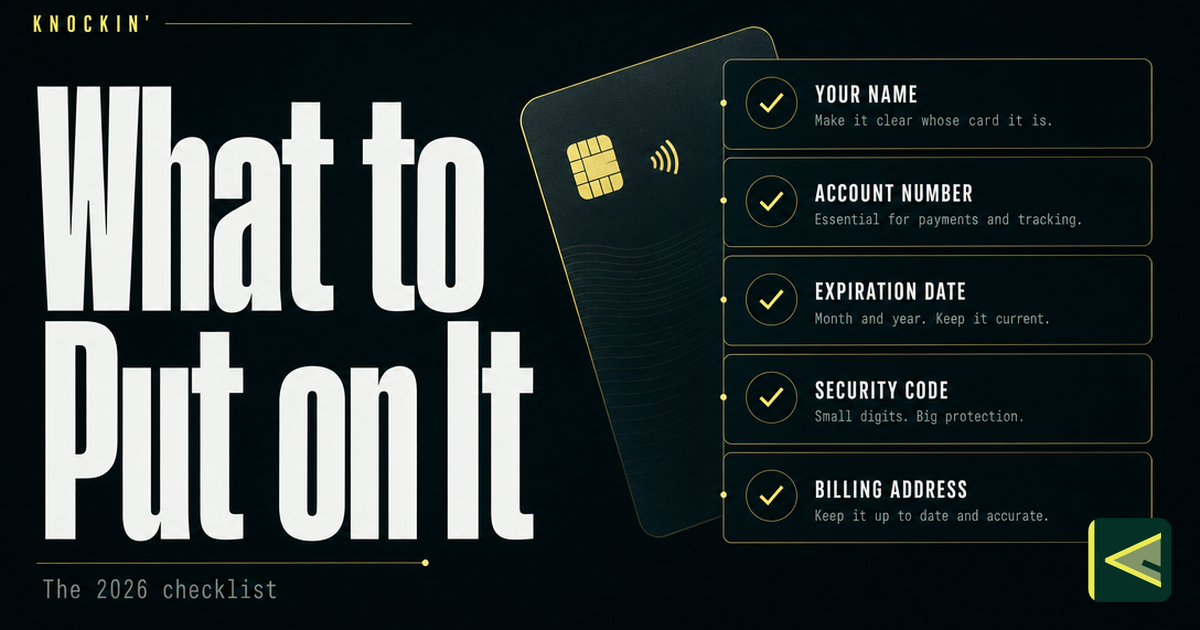
What to Put on a Business Card in 2026 (and What to Leave Off)
The complete checklist for what to put on a business card — five essentials, the modern optional layer, an honest leave-off list, and what…
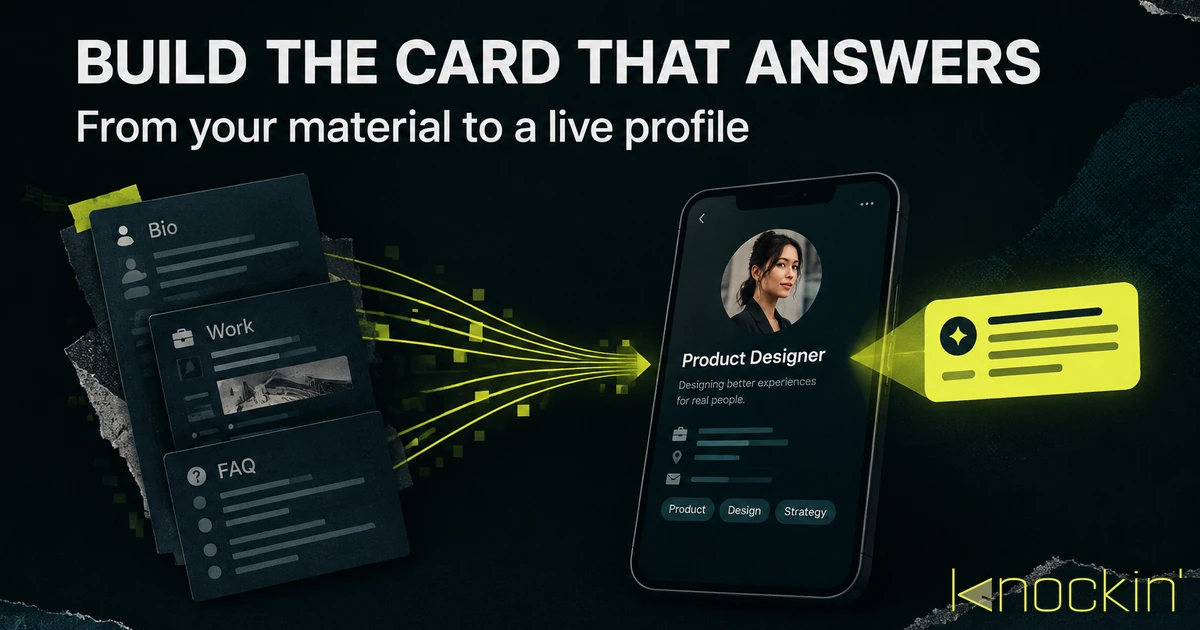
How to Create an AI Business Card (Step by Step)
A practical walkthrough for building a business card that answers questions for you: what material to gather first, how to set up and train…
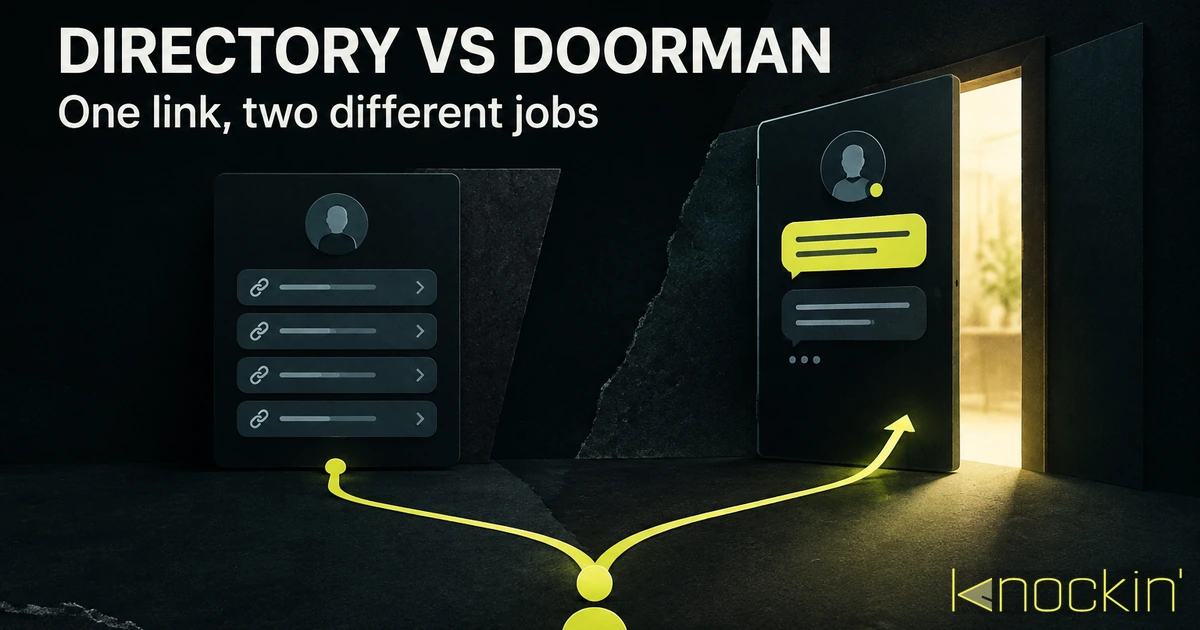
AI Business Card vs Link-in-Bio: Which One Works Harder?
Link-in-bio pages and AI business cards both compress you into a single URL — but one is a directory and the other is a representative.…
Frequently Asked Questions
How is an AI business card different from a personal website?
Will an AI business card sound like me or like a chatbot?
What should personal branding with an AI card include?
Does an AI business card replace showing up personally?
Your bio can finally answer back
Turn what you already know into an intelligent bio card that answers when you're not there.
Build, refine, and share in minutes — no credit card required.
https://knockin.info/blog/personal-branding-ai-business-card