
How to Use Knockin: Signup to LIVE Card, Handing Off Correctly
From Knockin signup to a LIVE card: onboarding, Card Editor, Knowledge, publishing, Tasks, and Credits — so your concierge answers until it should hand off.
You already know what to say about your work — the hard part is being there every time someone asks. New to Knockin? Start with our introduction to how Knockin turns your bio into a conversational card. What follows is the operational path from signup to a LIVE card that knows when to keep talking and when to stop.
Your Card and Your Concierge
Think of Knockin as two surfaces working together.
Your card is what visitors see first: name, role, company, contact details, and Showcase links to projects or work you want highlighted. It's the front door.
Speak to my AI is the conversation behind that door. The concierge draws on your Knowledge — facts you've written, files you've uploaded, corrections you've made in testing — to introduce you, answer questions, and collect intent.
When the concierge hits a boundary — partnership interest, hiring, pricing, anything that requires your call — it creates a Task instead of improvising. That decision boundary is the whole point: presence without pretending to be you.
Sign Up and Introduce Yourself
Registration is email-based. After you sign in, onboarding walks you through six steps that seed both your card and your concierge's starting Knowledge. The flow cannot be paused mid-way, so give yourself a few uninterrupted minutes. You can Skip for now on the file-upload step and return later.
You'll enter your name (and optional pronouns), pick up to three Roles and a Company, and add the public contact details you want on the card — email, phone, website, social links. This public email is separate from your registration email; visitors see what you put here. If you add a Website URL, Knockin reads the public page and uses it as Knowledge.
Then you meet your AI concierge. Choose a persona — Mochi, Alfred, Claire, or others — which sets the concierge's name, avatar, tone, and opening line. Use Chat Preview to ask questions as a visitor would. Wrong answers can be corrected on the spot; corrections become Taught by You Knowledge and apply immediately.
Upload a resume, portfolio, company deck, or any file that helps the concierge introduce you (PDF, MD, DOCX, TXT, MP3, JSON — up to 10 files, 25 MB each). Parsing runs in the background. Finally, tell Knockin your goals — why you're using it and what you want visitors to do next — and click Finish setup to enter Card Editor.
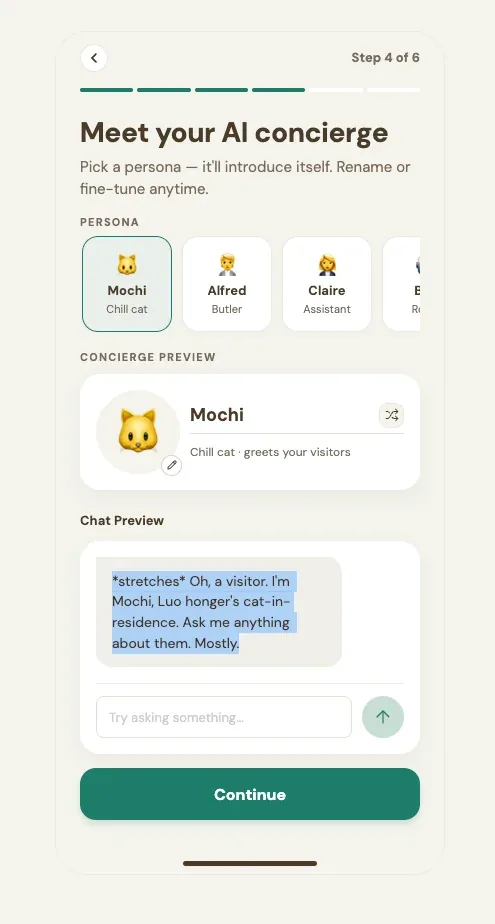 Choose a persona and test the concierge before anyone else does — corrections here become Knowledge immediately
Shape the Card Visitors See First
Once onboarding finishes, Card Editor controls the public face of your presence — what visitors see before they tap Speak to my AI. Pick a Template, adjust Colors and Background, and set Fonts for your name and body text separately. The editor's "Make it yours" framing is literal: a template is only the starting point, and every visual detail is meant to be bent until the card reads as you.
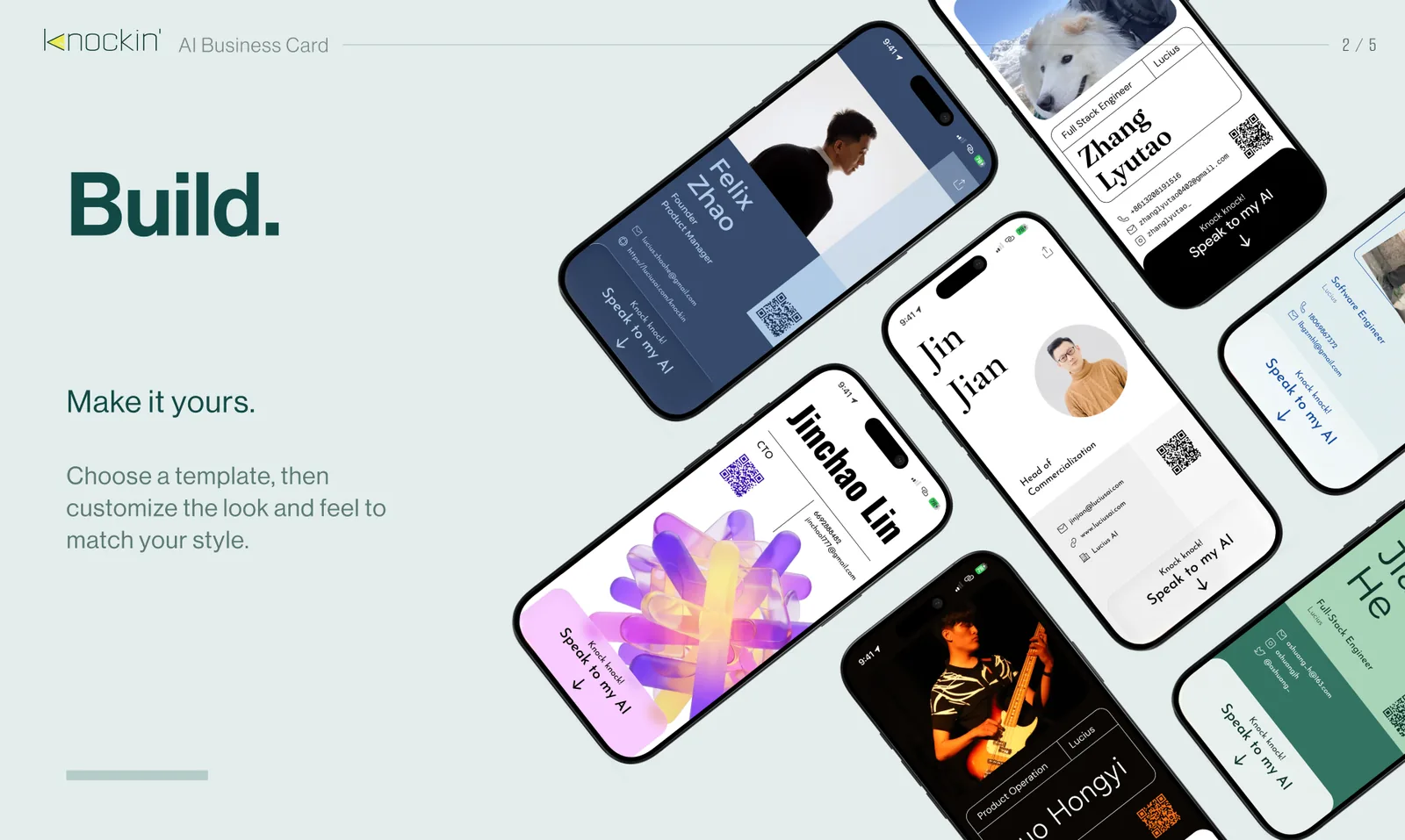 Make it yours — choose a template, then customize colors, background, and fonts to match your style
In Profile Layout, set your avatar, name, roles, and company. Contact Details holds phone, email, social links, website, and location — the fields visitors actually use to reach you.
Showcase highlights projects, products, or links worth a click. Each item has a title, description, thumbnail, and destination URL. You can add up to ten, reorder them, and hide individual items from the public card while keeping them in draft. Showcase clicks open external URLs directly; that content does not enter AI chat.
One thing easy to miss: edits auto-save as drafts. They do not change the live card until you click Publish changes again.
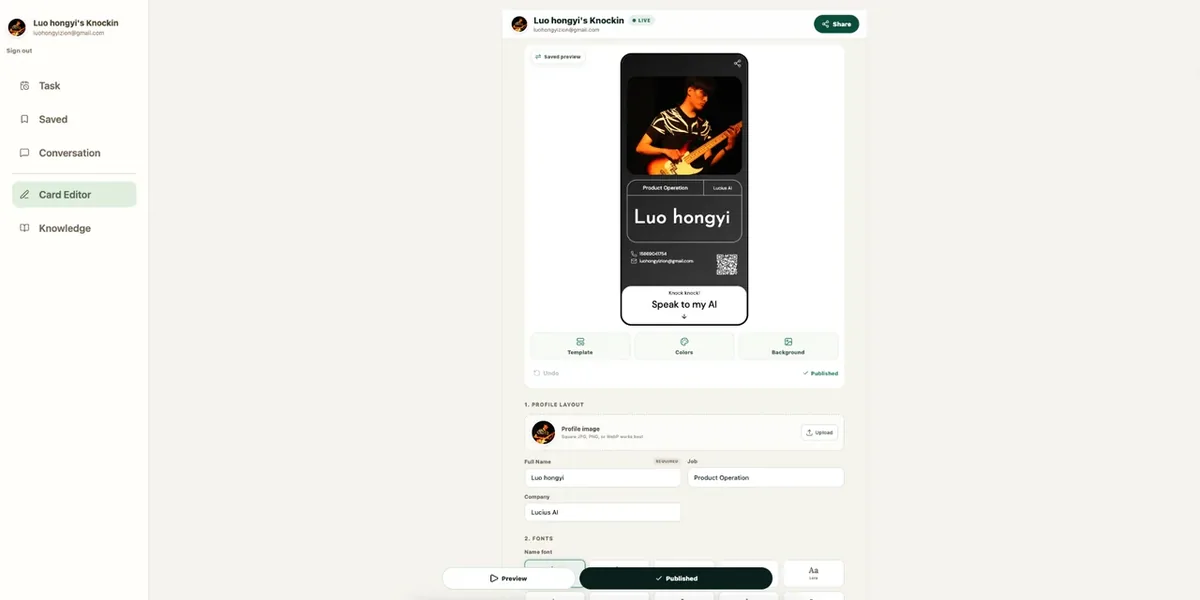 The Card Editor is where your public first impression takes shape — profile, styling, and Showcase in one place
Teach Your Concierge What You Know
Everything the concierge says flows from Knowledge — the memory you build and maintain over time. It organizes what you've taught it into categories:
- Persona — name, avatar, tone, opening line, persona description
- Identity — background, experience, who you help
- Offerings — services, products, capabilities
- Collaboration — how you work together, process, next steps
- Other — anything else worth knowing
- Files & connections — uploaded files, public links, parse status
You can add facts in plain language through Add Knowledge — write self-contained statements like "My working hours are Mon–Fri 10:00–19:00; I usually reply within 3 hours," not fragments like "3 hours." Uploaded files and public links are parsed in the background; retry failures under Files & connections.
When you reply to a visitor manually in a Task, Knockin extracts Knowledge from your reply automatically — no extra confirmation — and uses it immediately. The system does not yet distinguish one-off answers from permanent facts, so after temporary schedules, special quotes, or exceptions, check Knowledge for entries that should not persist.
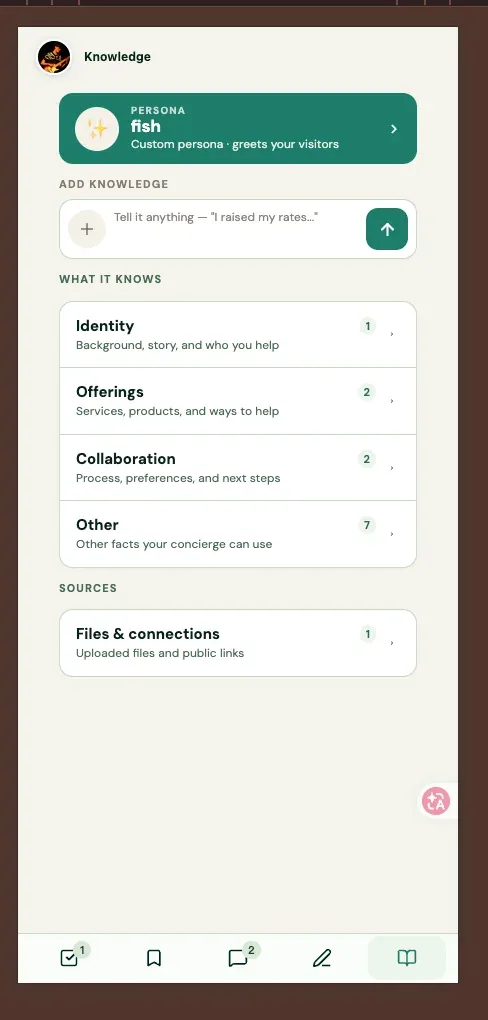 Knowledge is where your concierge learns who you are — persona, categories, and uploaded files all feed the same memory
Test Before You Publish
The best time to fix awkward answers is before a stranger asks them.
In onboarding Chat Preview or card preview test mode, ask the questions real visitors will ask: Who are you? What are you working on? How can you help me? I want to collaborate — what are the next steps? Can I book a meeting? Are you open to new opportunities? What always requires you personally?
When an answer is off, the fix is structured rather than a free-text rewrite. Flag the problem under What needs fixing? — wrong information, missing information, tone or style, too long or too short, or "shouldn't answer this" — and submit. The correction is applied immediately and the state flips to Knowledge Updated, so the next visitor gets the corrected answer without you re-explaining anything.
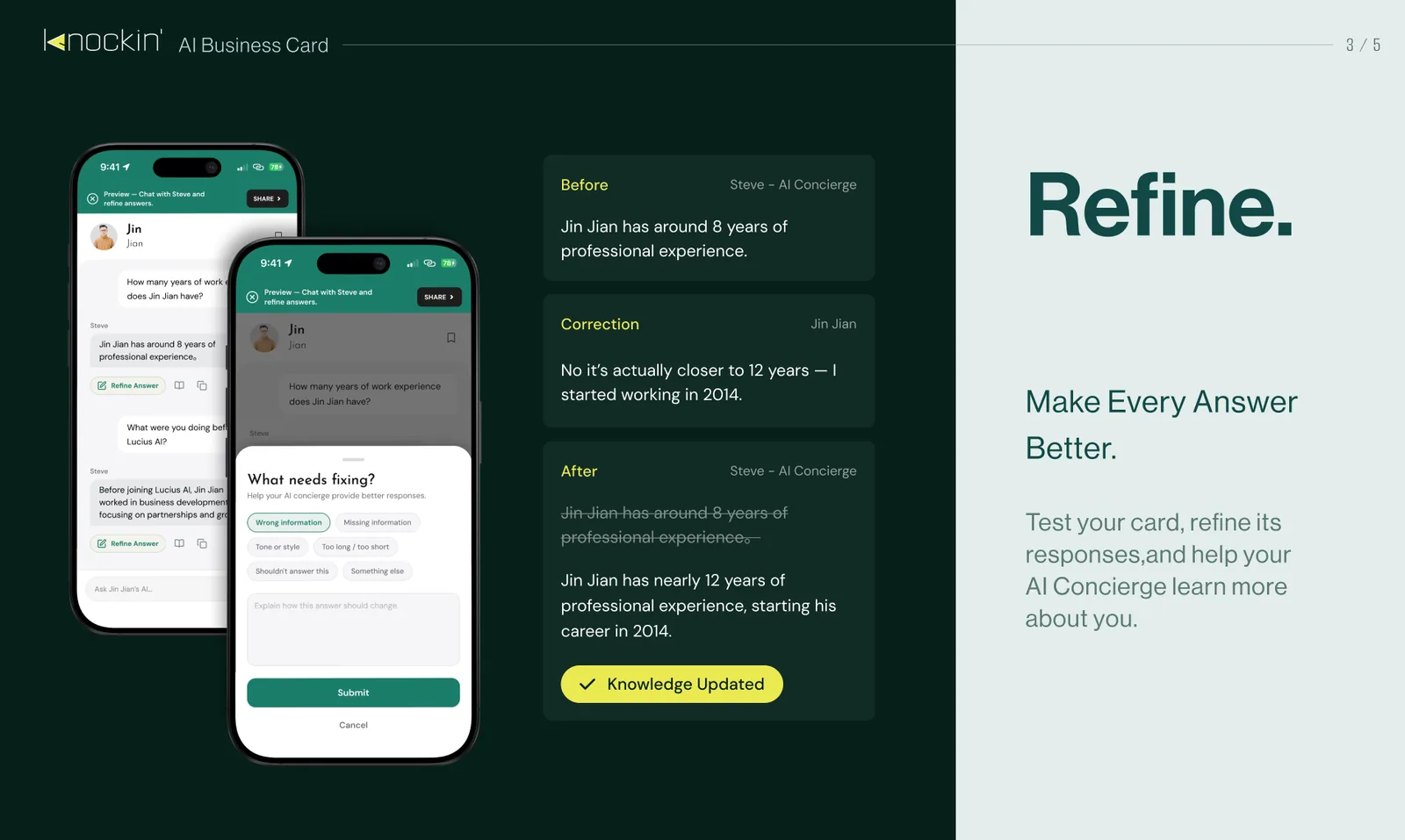 Refine an answer in Chat Preview — a correction becomes Knowledge instantly
You're ready to publish when basic intro matches your card, unknown answers are admitted rather than invented, partnership and hiring questions become Tasks, contact and meeting guidance is accurate, and tone matches your chosen persona.
Before you hit publish, also confirm: name, title, company, and public contacts are accurate; at least one avatar or hero image represents you; Showcase links open correctly; and you've tested five to ten real visitor questions.
Publish and Share One Link
In Card Editor, open Preview and test both the public card and Speak to my AI. Fix anything off, then click Publish changes. When LIVE appears at the top of Profile, your public link works.
One constraint worth noting: you cannot pause or unpublish a live card yet — confirm public info before publishing.
Share gives you several formats to match the moment: QR for business cards and events, Link for bios and signatures, Image for platforms where a card graphic travels better than a URL, and an NFC-enabled Wallet pass for a tap-to-open handoff in person. The Link page also supports WhatsApp, LinkedIn, X, WeChat, iMessage, Email, and system share menus.
Put the link where introductions already happen — social bios, email signatures, personal websites, slide decks, printed cards, badges, event posters.
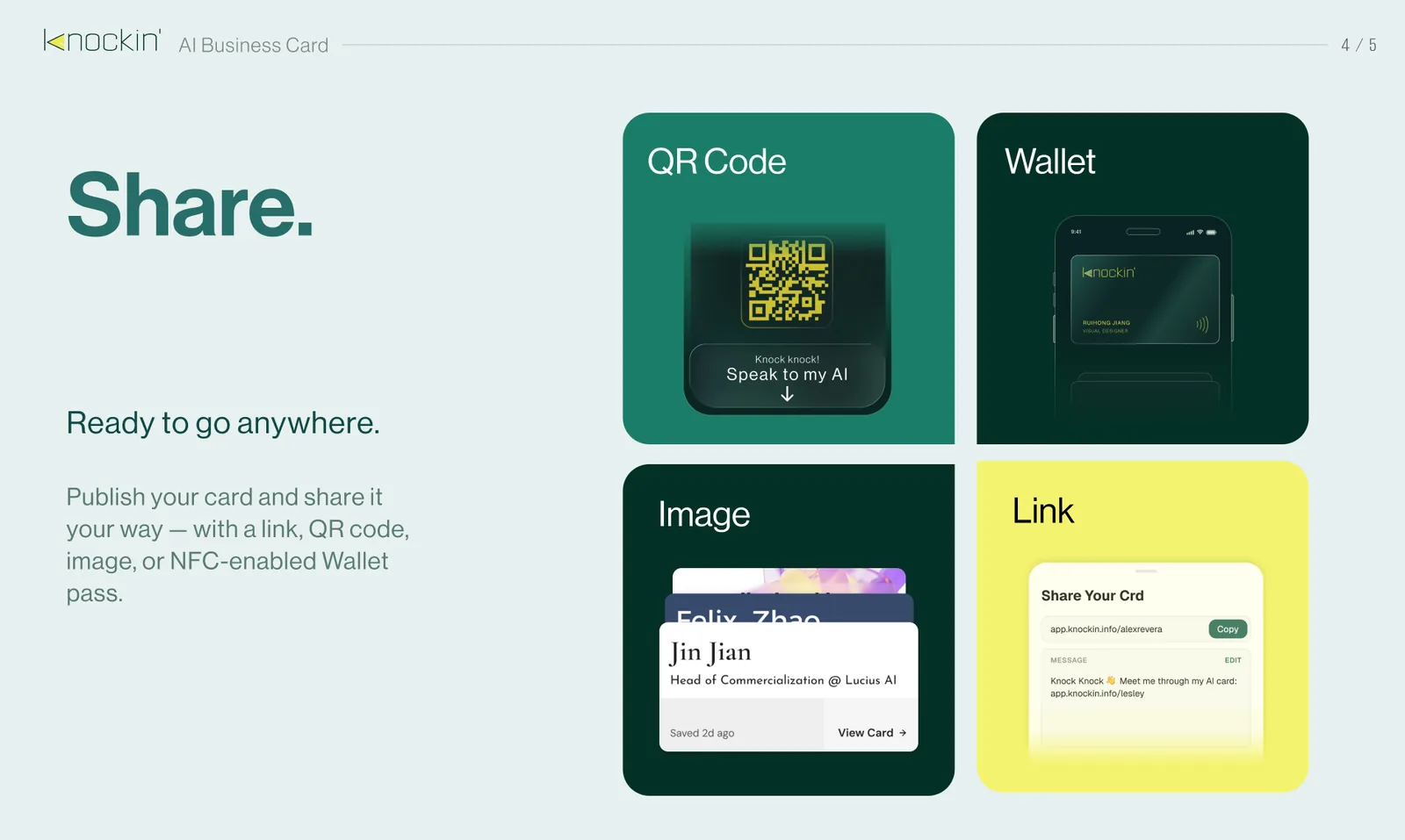 Share your way — link, QR code, image, or an NFC-enabled wallet pass
What Visitors Experience
When someone opens your card, they see your name, roles, company, contacts, Showcase, and QR. They can save the card to revisit later.
Tapping Speak to my AI takes them to Who's knocking? — where they enter a name or intent, or use Quick Prompts like About you or Book a meeting. From there, the concierge answers from Knowledge, collects name and email using flows you've taught, helps structure meeting requests, and creates a Task when partnership, hiring, or similar intent needs your decision.
The concierge hosts and informs. It does not confirm deals, accept jobs, or make judgment calls for you.
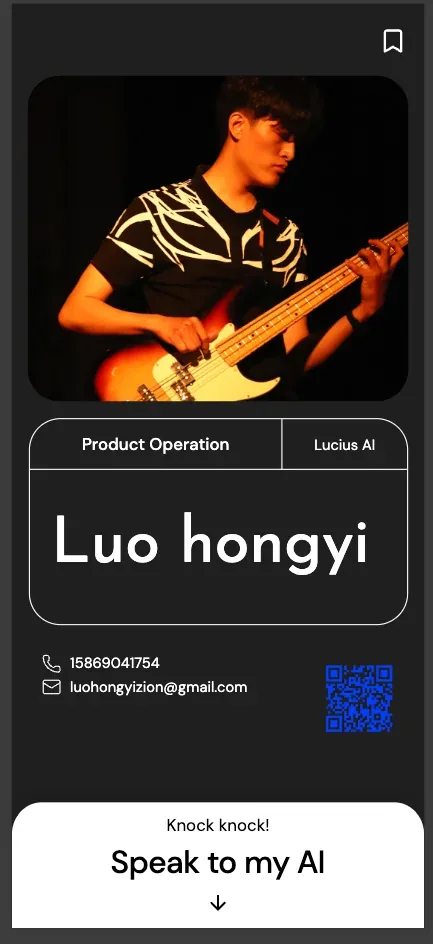 From a public card to a real conversation — visitors enter through Speak to my AI, not a contact form
Conversations and Bookmarks
Conversation lets you review what happened. Visitor Chats lists conversations between visitors and your concierge — open a thread to see questions, AI replies, your manual replies, Knowledge updates, and linked Tasks. My Chats stores conversations you had as a visitor on someone else's card; Continue this conversation in name card picks up where you left off.
Saved bookmarks other Knockin cards for easy revisit. Knockin is not a public social network — these features exist so you can follow up, not so you can scroll a feed.
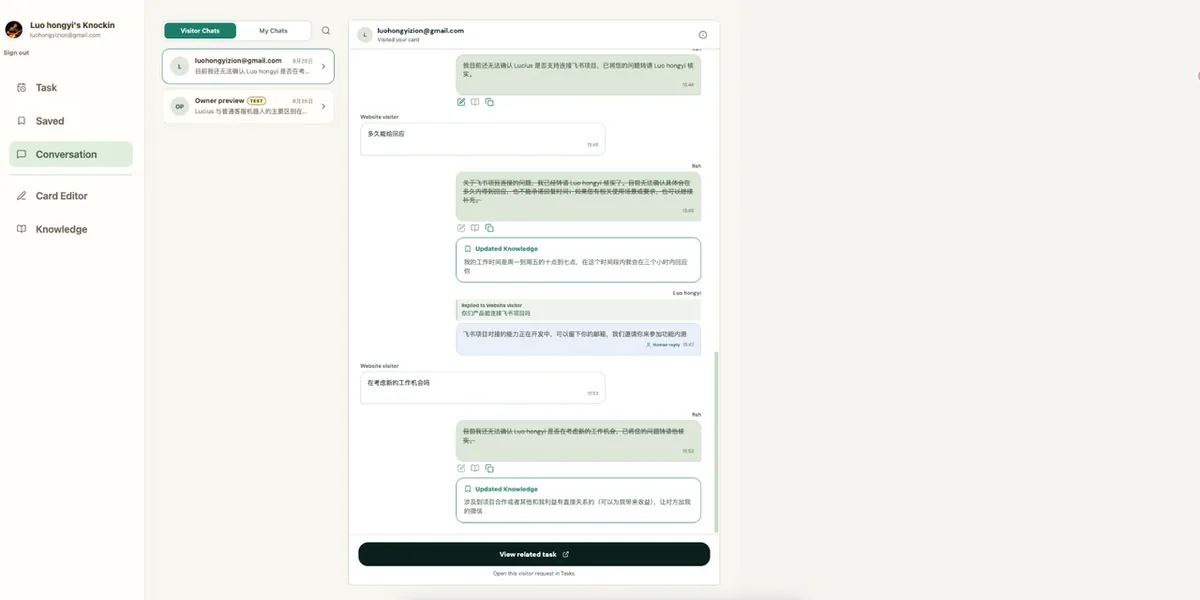 Visitor Chats is where you see what people actually asked — and whether your concierge got it right
When a Question Needs You
A Task appears when the concierge should not decide, or lacks a reliable answer: unknown questions, context it cannot confirm on your behalf, partnership or hiring intent, direct contact requests, or anything needing more background from you.
Tasks show as Answer needed until you resolve them. Open one, read the visitor message and full conversation context, use Suggested Quick Replies or write your own, then pick the action that matches whether the conversation should stay open or close.
When you reply, you choose among three actions depending on what should happen next. Reply only sends your message immediately but leaves the Task in Answer needed — use this when you expect follow-up. Reply and resolve sends your reply and moves the Task to Resolved. Reply, resolve & notify does the same and emails the visitor if Knockin has their address on file.
| Action | Visitor sees | Task status |
|---|---|---|
| Reply only | Your reply immediately | Stays open (Answer needed) |
| Reply and resolve | Your reply immediately | Moves to Resolved |
| Reply, resolve & notify | Your reply; email if address available | Moves to Resolved |
Manual replies also teach. After one-off answers, check Knowledge for entries that should not persist.
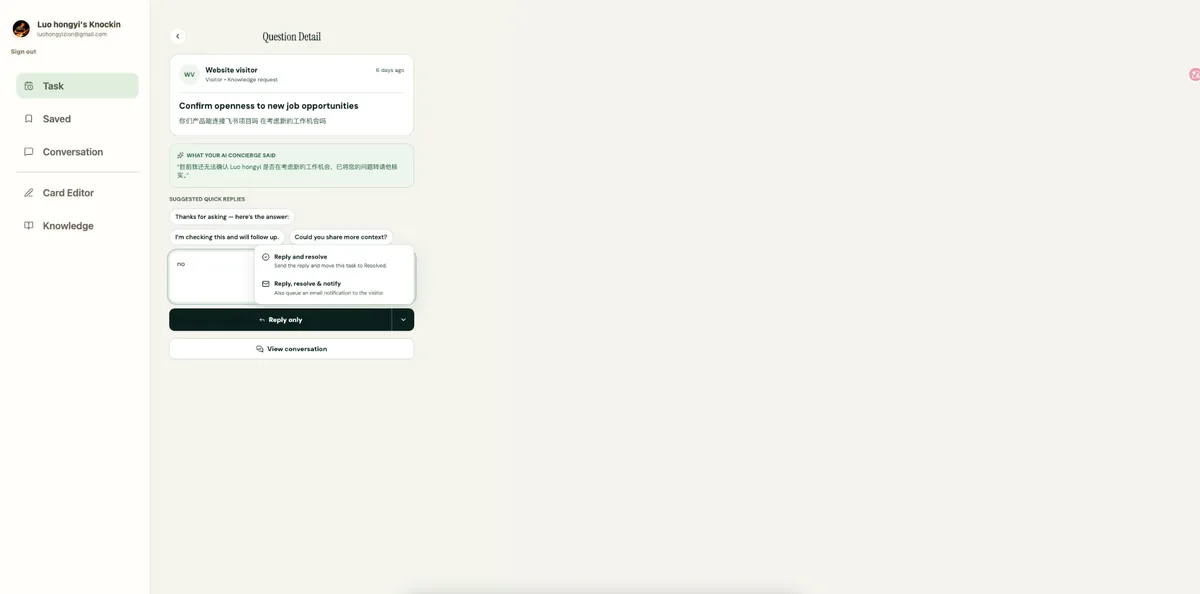 Tasks bring the conversation back to you with full context — suggested replies help you respond without starting over
Calendar, Notifications, and the Quiet Stuff
Under Profile, you'll find account name, registration email, public card URL, QR, and LIVE status. Account profile and public card profile are separate — your login email is not necessarily what visitors see.
Notifications, when enabled, email your registration address about new Tasks — not the public contact email from onboarding. Turning notifications off affects Task alerts only; trial, Credit, billing, or operational emails may still arrive.
Connect Google Calendar under Profile → Calendar: authorize Google, and visitors can describe meeting needs in chat. The concierge collects name, email, and intent, then reads or writes your calendar only after you confirm a booking. Reschedule or cancel through conversation afterward. Free/busy is not shown publicly; booking details are confirmed in chat. Only one Google Calendar is supported today.
Once connected, the card shows a Meeting Requests view and a live month grid marked Synced with Google Calendar. When a slot is confirmed, the visitor sees it plainly — "Meeting Confirmed — it's added to your calendar" — so the booking loop closes without a separate email thread.
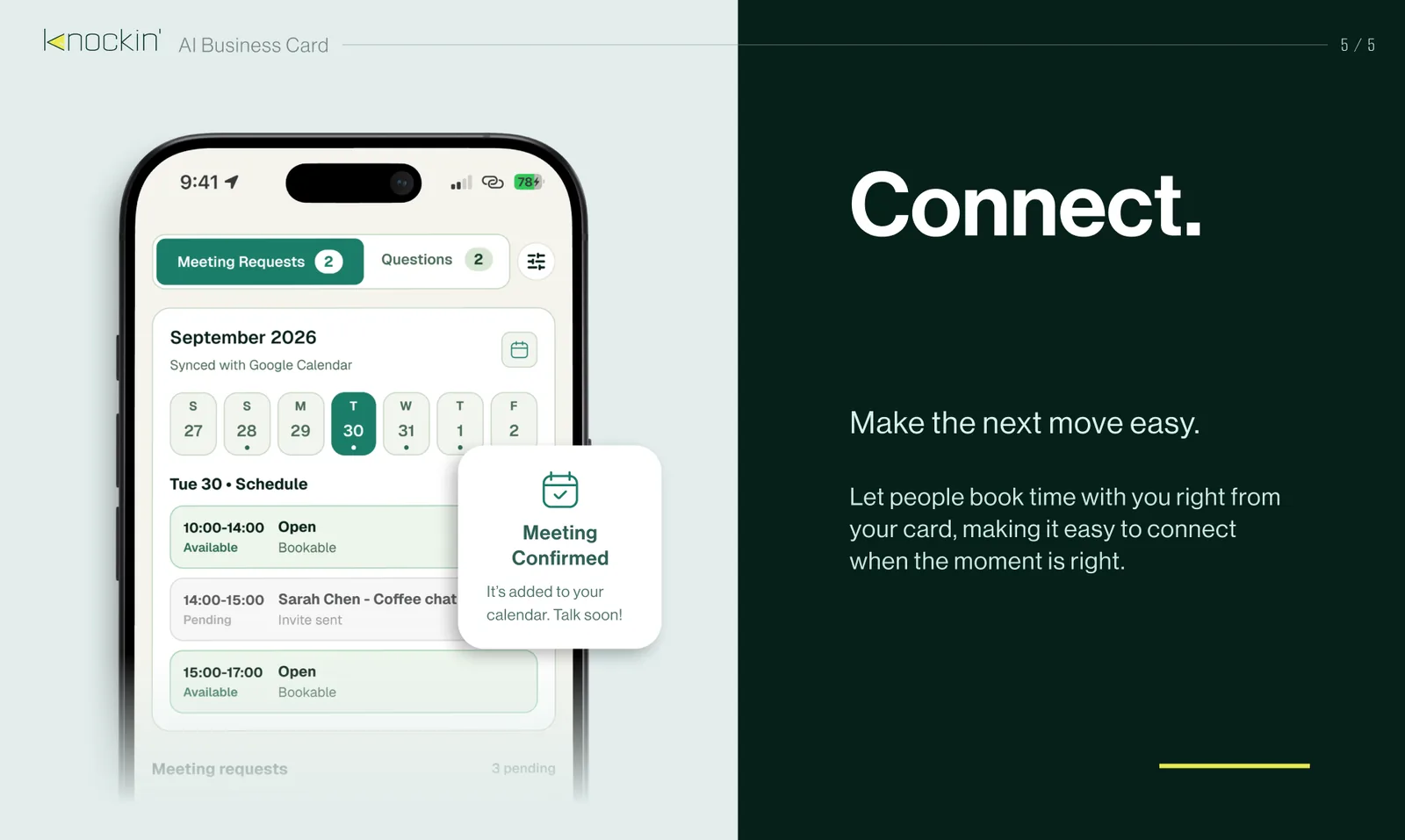 Connect your calendar once — visitors book time from your card, and you confirm before anything is scheduled
Trial, Credits, and Keeping the Conversation Alive
Credit powers concierge AI runs; exact per-action costs are shown in the product.
The free trial lasts seven days with 500 Credits included. Trial Credits do not refresh or roll over. Paid plans grant monthly Credits; unused Credits do not carry to the next month. Plan changes take effect immediately.
When Credits run out, your public card, contacts, Showcase, share links, and editor stay available — but Speak to my AI stops replying. If your card is still public, renew before Credits expire so visitors are not left unanswered.
Billing & Subscription shows trial or plan status, remaining Credits, and recent activity. Credit Usage charts consumption over 7, 30, 90 days, or custom ranges.
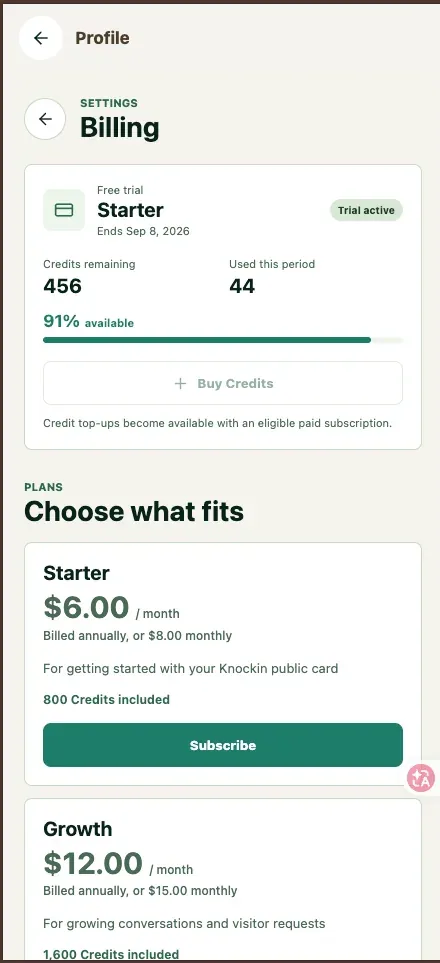 Keep an eye on Credits if your card is live — the page stays up, but the conversation stops when they run out
Conclusion
A useful Knockin is not the one with the most information — it's the one that introduces you accurately, keeps answering when it should, and hands off when it should not. Most of that comes from a handful of recurring habits rather than a one-time setup sprint.
Start with identity, capabilities, collaboration rules, and contact boundaries. Write explicit Knowledge about what the AI must not decide for you. Test with real visitor questions before publishing. Resolve Tasks promptly so visitors know someone is listening. Review auto-learned Knowledge regularly and delete expired or one-off facts.
Bring what you already know. Publish a link that can answer back. Improve from real questions instead of guessing what people want to hear.
Related Posts

Introducing Knockin: Your Bio Can Finally Answer Back
Knockin turns what you already know into an intelligent bio link that answers questions when you're not there. Build, refine, and share in…
Why Knockin Is a Door: Design Decisions Behind a Bio That Answers
Why Knockin looks the way it does — a founder's case for the name, the K, the deep-green paint, and the mosaics behind a bio that answers…
What Is a Digital Business Card: The Card That Answers Back
A live profile shared by link, QR, or NFC — and AI now turns static cards into ones that answer and hand off judgment calls. Here's how the…
Frequently Asked Questions
How long does first-time Knockin setup take?
Why do visitors still see my old card after I edited it?
Will Knockin accept partnerships or job offers on my behalf?
What is the difference between my registration email and public contact email?
Why did Speak to my AI stop replying?
Do manual Task replies automatically become Knowledge?
Ship a LIVE Card with Decision Boundaries
Set up Knowledge, Tasks, Credits—your concierge answers.
Test with real questions; it hosts, not closes deals.
https://knockin.info/blog/how-to-use-knockin