
AI Business Card: The Complete Guide (2026)
An AI business card answers questions and captures intent from your own knowledge. This guide covers how the AI layer works, who it fits, and its limits.
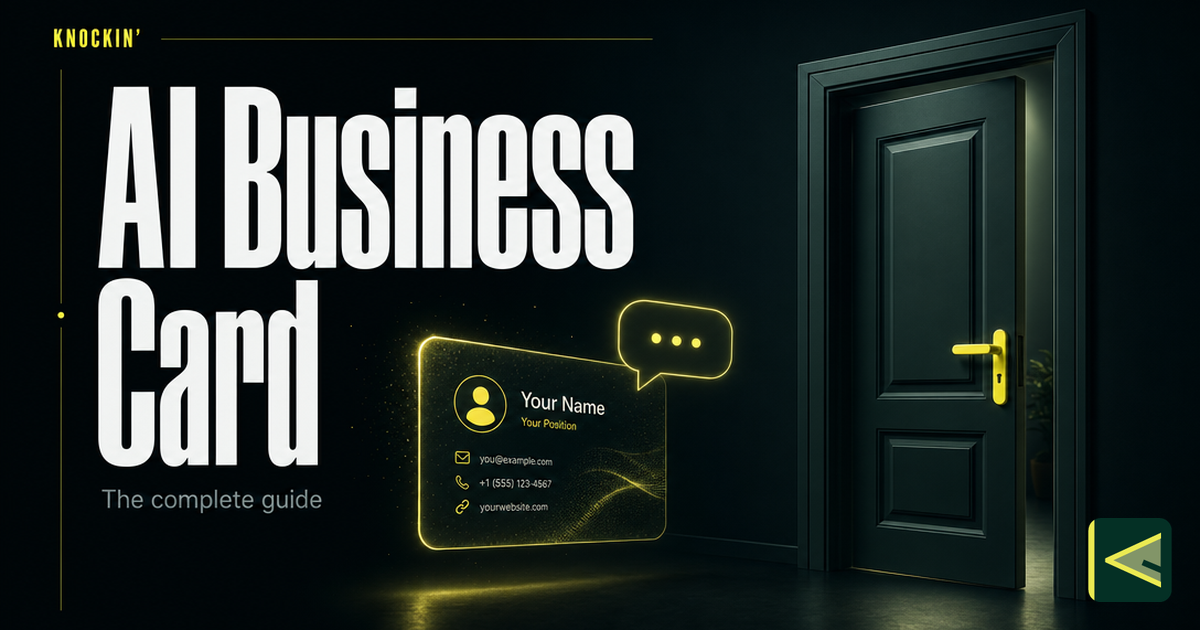
An AI business card is a digital business card with a conversation layer built in. It carries the basics every card carries — name, role, company, links, how to reach you — and then does the one thing no earlier format could: it answers. Drawing on knowledge you provide, it replies to visitor questions, captures what each person actually wanted, and hands the judgment calls back to you instead of improvising them. If a static card tells people who you are, an AI card tells people who you are, then keeps talking.
The category exists because the earlier formats left one gap untouched. Paper cards froze your details at print time. Digital cards fixed that — the profile lives online, updates everywhere at once, and saves to a visitor's phone with one tap. But both are one-way statements. The stranger holding your card still has to invent the next question, and if you are asleep, in a demo, or across a conference hall, the introduction quietly dies in the gap between curiosity and conversation. An AI business card is built to stand in that gap.
This guide is the complete picture: a working definition and the three-tier history behind it, how the AI layer actually works, what it changes in practice, which tools build AI cards in 2026, who the format fits and who it honestly doesn't, the limits worth planning for, and how to start. Where we mention our own product, Knockin, we have tried to describe it with the same fairness as everyone else.
What Is an AI Business Card?
An AI business card is a shareable professional identity — delivered by link, QR code, NFC tap, or wallet pass — with an AI layer that holds a conversation on your behalf. The card half carries your identity: who you are, what you do, where your work lives, how to reach you. The AI half draws on knowledge you have approved to answer questions, capture visitor intent, and escalate what matters to a human — you. The shortest version: a card that answers back.
To see what is new here, place the AI card at the end of a three-step evolution.
Tier one: the paper card. A format that survived a century because it fits a wallet and an etiquette. Its weakness was never the look; it was the lifecycle. The moment a card is printed it becomes a frozen snapshot — change your number, title, or company, and every copy you ever handed out is silently wrong. The recipient types your details in by hand, or doesn't bother, and the card retires to a drawer.
Tier two: the static digital card. Digital cards fixed the lifecycle. As our existing guide explains, a digital business card is a live professional identity you can share — by link, QR, NFC, or wallet pass — which updates instantly when your details change and hands the recipient something they can act on immediately. You create the profile once, and every door leads to its latest version: no reprint, no retyping, no drawer. (If you want the full mechanics of how one profile serves all those doors, see how digital business cards work, and for the format itself, what is a digital business card.) What tier two never fixed is the handshake itself. The static card is still a statement handed over. It tells, and then it waits.
Tier three: the conversational AI card. This is the current step of the category, and the subject of this guide. The AI card takes the living profile from tier two and attaches an intelligence that can speak for it. A visitor opens your card and asks what they actually want to know — what you really do, whether you have worked with teams like theirs, what you charge, whether you are free next week — and gets an answer drawn from material you chose to share, at any hour, without you in the room.
It helps to name what an AI business card is not. It is not an AI design generator: tools that produce printable card layouts are design tools, and their output is still a static object. It is not a video or voice recording behind a QR code; playback is not conversation. And it is not a generic chatbot pasted onto a profile page. The difference is ownership of knowledge. A real AI card answers from what you have taught it about yourself, admits what it doesn't know, and knows which decisions belong to you. That test — does it answer from your knowledge, and does it hand judgment back? — separates the category from its imitations.
How the AI Layer Actually Works
Four mechanics do the work in every serious AI card: a knowledge base, grounded answering, task handling, and a refinement loop. Products differ in how they implement each one, so this section uses Knockin — the product we know from the inside — as the working example, with the caveats that apply across the category.
The knowledge base is the card's education. You teach the card what you know by feeding it material you already have: your profile and role, the services you offer, your work history, links, pricing or availability if you choose to share them, and answers to the questions you get most often. This is the same inventory exercise as deciding what to put on a business card, extended one level deeper. The static card holds the claims; the knowledge base holds the explanations behind them — process, engagement models, boundaries, and what you don't do. With no knowledge base, an AI card has nothing true to say. The quality of the card is capped by the quality of what you teach it.
Answering is grounded, not improvised. When a visitor asks something, the AI answers from approved knowledge — "never invented context," in Knockin's wording — and every response traces back to material you chose to share. Equally important is the refusal behavior: a well-built AI card declines questions it cannot support rather than guessing, and pauses around private, sensitive, or high-impact topics instead of freelancing an opinion. [Source: https://knockin.info/features/ai-agent] A card that confidently invents an answer to "what's your rate?" is worse than no card. Grounding and refusal are the features that make the format safe to leave alone with a stranger.
Tasks turn conversations into motion. The most common task is scheduling: Knockin connects to Google Calendar, collects the visitor's details and intent, finds an open time, and books the meeting once you confirm it. The second is handoff. When a conversation reaches a point where a human should decide — a negotiation, a sensitive request, an opportunity with real stakes — the AI stops and brings you in with the context intact: a clean summary, the visitor's captured intent, and the next action already clear. [Source: https://knockin.info/features/ai-agent] The card does not close deals. It makes sure the deal reaches you in a shape you can act on.
The refinement loop is how the card gets better. Launch is not the end of training. You configure the card's tone, topics, goals, and stop conditions, then test it with the questions real visitors ask and tighten the answers until they sound like you. Over the following weeks, the pattern of visitor questions tells you exactly what to teach it next. Be clear about what "learning" means here: the card doesn't silently rewrite itself based on chatter — you stay the editor, and the loop is deliberate. An AI card that is never refined drifts toward generic, which is why products that take this seriously make testing a first-class step rather than a hidden menu.
What an AI Card Changes in Practice
Three shifts matter more than any feature list: presence stops depending on your schedule, one story serves many people at once, and every introduction leaves a trace.
Presence without attendance. The investor who opens your card at midnight, the prospect comparing three shortlisted freelancers on a Sunday, the conference contact who scans your badge and looks you up from the train home — none of them will email first, and all of them will judge quickly. A static profile shows them a claim. An AI card lets them interrogate the claim. Presence stops being a performance you give in person and becomes a property of the card itself. Knockin's homepage frames this as a presence that can speak for you even when you're not there — which is the entire value proposition in one sentence. [Source: https://knockin.info/]
Scale without repetition. Ask anyone who networks for a living what introductions cost, and the answer is usually the same story told hundreds of times. The AI card holds the repeatable layer — who you are, how you work, the standard answers — while you keep the layer that actually differentiates you: the judgment, the relationship, the bespoke thinking. That division of labor is the honest framing. The card is not you; it is the part of you that was going to say the same thing anyway. Freed from the reruns, your in-person attention goes where it counts.
Traces instead of silence. With a static card, you learn nothing after the handoff. With an AI card, every question leaves a trace — what people asked, in what order, where they hesitated. Read together, the questions are a research instrument: they tell you which parts of your story land, which claims trigger follow-ups, and what your audience wants that you haven't explained yet. Knockin's homepage puts this aptly — every question leaves a trace — and after a few weeks of real questions, the traces are often more valuable than the answers. [Source: https://knockin.info/]
One caution belongs here: these gains are real but not free. They depend entirely on the knowledge base being good and current, which is why the limits later in this guide matter as much as the benefits.
The AI Business Card Landscape in 2026
The young market splits by what each builder started from: some began with a physical NFC card and added intelligence, some began with the link-in-bio profile and added intelligence, and some were built AI-first. Where a product started predicts what it is good at.
ChatbotCard: the hardware-first take. ChatbotCard combines a physical NFC card, a QR code, a digital business card, and a conversational AI trained on what you upload — company details, product information, FAQs, documents, brochures, knowledge bases, and website content. [Source: https://chatbotcard.com/] Its strength is the in-person moment: a visitor taps the physical card, no app download required, and lands in a conversation that can answer questions, capture leads — names, emails, phone numbers, survey responses, and full conversation logs — and present media like catalogs and testimonials. It is aimed at people whose work happens in the field: contractors, real estate professionals, insurance agents, financial advisors, attorneys, and consultants, with cards shipping in three to five business days. [Source: https://chatbotcard.com/] If you want an object to hand someone that keeps working after you walk away, this is the archetype. The trade-off is the hardware itself: you are buying and shipping physical cards, and the experience is built around the tap. (If the NFC angle is new to you, our explainer on NFC business cards covers how the tap itself works.)
Knockin: the AI-native bio card. Knockin, our product, started from the introduction rather than the card stock. The unit of work is your bio: bring the materials you already have, and Knockin shapes them into one intelligent card built in three steps — Build (choose a template and make it yours), Refine (test the card and make every answer better), and Share (publish it your way: link, QR, wallet pass, NFC, or an embeddable widget). [Source: https://knockin.info/] Visitors start a conversation with your AI concierge, which greets them in your voice, answers from your approved knowledge, books meetings through Google Calendar when the moment is right, and hands high-stakes moments back to you with the context intact. Setup is measured in minutes, and you can start free without a credit card. [Source: https://knockin.info/] The trade-off is symmetric: there is no physical card in the box. Knockin travels as software, and its center of gravity is the personal introduction, not the trade-show handout.
Early entrants and the incumbents. The space is young enough that some players are barely public. 1Persona, for example, currently presents itself as an AI networking product, but its public site says little about how its AI actually works. [Source: https://1persona.ai/] Treat a thin site as a reason to test directly rather than a reason to dismiss. Meanwhile, the established digital card platforms own the tier-two market and are attaching assistants to static profiles; when you evaluate any of them, apply the same test from earlier in this guide — does the AI answer from knowledge you control, and does it hand judgment back?
A compact comparison of the two we could verify in depth:
| ChatbotCard | Knockin | |
|---|---|---|
| Started from | Physical NFC card | Personal bio link |
| Core loop | Tap, conversation, lead capture | Build, Refine, Share |
| Knowledge source | Uploaded docs, FAQs, website content | Your profile, work, services, approved material |
| Strongest at | Field and in-person professions | Personal introductions that scale |
| Trade-off to accept | Hardware purchase and shipping | No physical card; bio-first scope |
Who an AI Card Fits — and Who It Doesn't
The format fits when your next step depends on being understood quickly and the same questions arrive again and again. Founders explaining a business that doesn't fit in one line. Freelancers and consultants whose prospects do due diligence at midnight. Sales and business development people who meet more people than they can follow up with. Creators whose body of work deserves a conversation, not a link list. The common thread: you already have the answers, and access — not information — is the bottleneck.
It fits less well than the marketing suggests in three cases. First, if your introductions are rare and high-touch — a handful of clients a year, each worth a personal reply — a static card plus your own attention may serve you better than an AI layer you have to maintain. Second, if you cannot or will not keep the knowledge base current, the card will quietly become a confident source of outdated answers, which is worse than silence. Third, if what you actually need is a pipeline tool — stages, sequences, team reporting — you need a CRM. An AI card lives at the edge of the funnel where people meet you, not in the middle where you manage them.
There is also a temperamental fit, and it deserves honesty. An AI card speaks for you when you are not there. If that idea sits badly with you at a level no feature list will fix, that is a legitimate answer, and the tier-two card remains a fine tool. The format rewards people who want to be findable and understood; it does not suit people who want every word to pass through their hands first.
The Limits Worth Planning For
Three limits do not go away with better products; you simply learn to manage them.
It can be wrong, or it can refuse. Grounding sharply reduces invented answers — the card answers from what you approved and declines the rest — but a knowledge base with an error in it produces confident errors, and a card that declines too eagerly frustrates visitors. Both failure modes are yours to tune: fix the source, refine the boundary. Never let an AI card make commitments you wouldn't stand behind — rates, legal terms, medical or financial advice — and prefer products whose default on sensitive, high-impact questions is to hand them to you rather than answer. [Source: https://knockin.info/features/ai-agent]
Conversations are data, and data is a responsibility. An AI card collects what people ask — sometimes including personal, sensitive, or commercially delicate material — along with contact details if the card captures leads. Before you deploy one, know what is stored, where it is processed, how long it is kept, and how to delete it. Your visitors did not choose your vendor; you did. Privacy practice is part of the product decision, not an afterthought, and a vendor that can't answer those questions plainly hasn't earned your introductions.
The card decays without gardening. Change your rate, your offer, your calendar link, your positioning — and the card will cheerfully keep explaining last year's version of you. A workable rhythm: after launch, review the week's questions and tighten answers once a week for a month; monthly after that; and always immediately after any real change to your work. The refinement loop is the feature that makes this ten minutes instead of a rebuild, but only if you show up for it.
How to Start With an AI Card
Starting is one honest afternoon, not an integration project. The steps, in order:
- Inventory what you already say about yourself. Your site's about page, your best pitch email, the answers you wrote twice this week. Deciding what to put on a business card is the same discipline, one layer down.
- Teach the knowledge base and set the boundaries. Feed the material in, then set the tone, topics, goals, and stop conditions — the questions the card must bring to you rather than answer.
- Refine before you publish. Ask the card the ten questions real visitors will ask. Tighten until the answers sound like you on a good day.
- Share one link everywhere introductions happen. A QR code in physical contexts, a wallet pass to make the introduction durable, NFC where taps are natural, and the link in your email signature and bios. Our guide to sharing a digital business card maps all the doors.
- Watch the traces. Read what visitors actually asked, fix the gaps, repeat. The first two weeks of questions are the best product research you will ever get for free.
If you want to see the loop running end to end, you can start a Knockin card for free — no credit card, live in minutes at knockin.info.
Conclusion
An AI business card is a digital card that answers back: a living profile with a knowledge base behind it, grounded answers in front of it, and a handoff that keeps judgment where it belongs — with you. That is the whole idea, and everything else in this guide — the three-tier history, the mechanics, the 2026 landscape, the limits — is detail hanging off that one sentence.
The honest summary of the format: it buys presence, scale, and signal, and it charges you maintenance, privacy diligence, and the discipline to keep your own knowledge current. For people whose opportunities arrive when they are not in the room, that trade is usually worth making. For people whose introductions are few and personal, a tier-two card is still a perfectly good tool — our guides on digital business cards and what to put on a business card cover that path well.
If the conversational tier sounds like yours, the fastest way to understand it is to build one. Start free at knockin.info — bring a bio, teach it what you know, and ask it the questions your visitors ask. If you'd rather read the backstory first, see why we built Knockin as a door or start with the introduction post.
Related Posts
What Is a Digital Business Card: The Card That Answers Back
A live profile shared by link, QR, or NFC — and AI now turns static cards into ones that answer and hand off judgment calls. Here's how the…
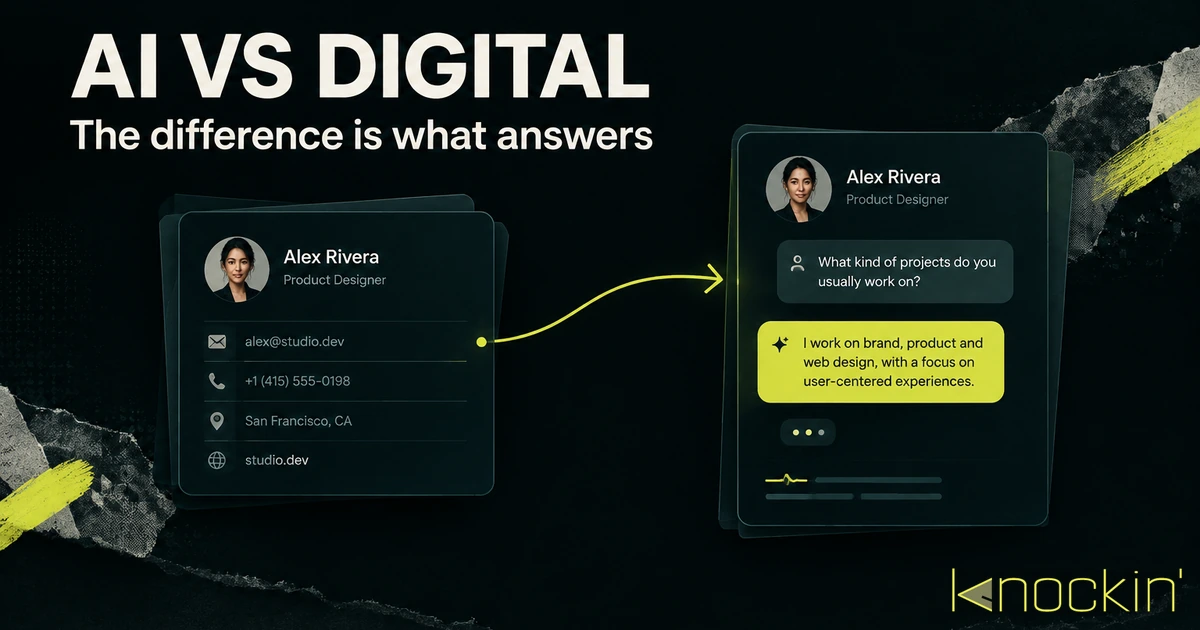
AI Business Card vs Digital Business Card: The Real Difference
Every AI business card is a digital business card, but not the other way around. Here is the distinction that actually matters — which…
The Best AI Business Cards in 2026 (Honest Comparison)
Which AI business card is actually worth your time in 2026? An honest map of the field: conversational cards like Knockin and BizCard,…
Frequently Asked Questions
What is an AI business card?
How is an AI business card different from a digital business card?
Can an AI business card give wrong answers?
What should I teach my AI card?
How much does it cost to start?
Your bio can finally answer back
Turn what you already know into an intelligent bio card that answers when you're not there.
Build, refine, and share in minutes — no credit card required.
https://knockin.info/blog/ai-business-card